
Electrical safety for high load vehicles
Know how to keep your truck or load from touching overhead powerlines that can cause serious harm.
Keeping high load drivers safe around electricity
For drivers who have a high load of materials or are transporting large plant items, the risk of hitting power lines is real and needs to be managed. You can be injured without directly contacting an overhead power line, as electricity can arc across open spaces.
High load drivers must plan their routes carefully to avoid low-clearance hazards and ensure safe transport of oversized equipment.
Stay safe when driving near overhead powerlines

Learn the height and voltage of the overhead power lines in your work area
Place stickers in the cabin of your vehicle displaying its height in the stowed, operating and transport positions
Do not attempt to directly measure the height of overhead power lines, as this could cause serious injury or death if the electricity were to conduct through the tape measure, then you!
Be aware that power line heights vary. So, a visual inspection for changes in power lines should be carried out before commencing any activity or passing near or under them. Be aware that the apparent height of power lines will vary depending upon the angle from which they are viewed
Provide workers with accurate, up-to-date maps and diagrams that show the location of power lines at work sites
Design safe traffic paths at work sites, well away from power lines, for the transit of high load vehicles
Assign a competent safety observer for each work team, to guide high load vehicles entering, travelling through, or leaving the work site to the assigned destination or exit point
Before every relocation, lower all machinery to the transport position. Never drive away with the tray up (or in the process of lowering)
Ensure that the maintenance and storage of high load vehicles is carried out well away from power lines
Provide ground barriers to ensure that high load vehicle transit cannot take place near power lines
Always treat power lines as live, even though they may appear to be dead
Learn the height and voltage of the overhead power lines in your work area
Place stickers in the cabin of your vehicle displaying its height in the stowed, operating and transport positions
Do not attempt to directly measure the height of overhead power lines, as this could cause serious injury or death if the electricity were to conduct through the tape measure, then you!
Be aware that power line heights vary. So, a visual inspection for changes in power lines should be carried out before commencing any activity or passing near or under them. Be aware that the apparent height of power lines will vary depending upon the angle from which they are viewed
Provide workers with accurate, up-to-date maps and diagrams that show the location of power lines at work sites
Design safe traffic paths at work sites, well away from power lines, for the transit of high load vehicles
Assign a competent safety observer for each work team, to guide high load vehicles entering, travelling through, or leaving the work site to the assigned destination or exit point
Before every relocation, lower all machinery to the transport position. Never drive away with the tray up (or in the process of lowering)
Ensure that the maintenance and storage of high load vehicles is carried out well away from power lines
Provide ground barriers to ensure that high load vehicle transit cannot take place near power lines
Always treat power lines as live, even though they may appear to be dead
Minimum safe approach distances driving under powerlines
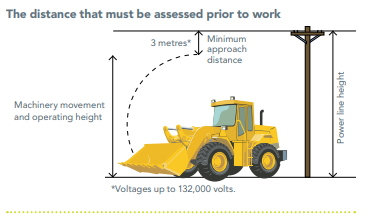
An ‘approach distance’ is the amount of space required to be kept between machinery, or anything held by a person, and power lines to prevent electricity arcing to you.
When considering the minimum distance required to safely drive vehicles under power lines remember to include the load, exhaust pipe and attachments such as rotating/flashing lights or radio aerials.
| Power lines with voltages up to 132,000 volts | e.g. low voltage distribution and subtransmission lines, usually on poles | 3 metres |
| Between 132,000 and 330,000 volts | e.g. subtransmission and transmission lines, usually on either poles or towers | 6 metres |
| More than 330,000 volts | e.g. transmission lines usually on towers | 8 metres |
Machinery at risk at touching overhead power supply
| Plant and equipment | Key areas at risk of contact |
| Tractors | Exhaust, aerial and pulling implements |
| Implements | Wings fold at transport mode and width |
| Harvesters | Aerial, exhaust, unloading chute |
| Tippers | Exhaust, aerial and raising bin |
| Stock crates | Loading and unloading, walking along top |
| Cotton module makers | Tramper ram left extended and operating, and dumping activities |
| Irrigators | Raising or standing pipes vertically, water jet, and travelling underneath |
| Sprayers Excavators/backhoes | Booms fold at transport mode and width |
| Dozers | Operating, relocating, digging and cleaning dams – arm, knuckle bucket |
| Augers/grain equipment | Pushing and stacking timber Raising roadways reduces clearances |
| Cranes | Storage bin position and moving augers High boom, swaying rope and loads |