img

Understanding your responsibilities

It is your responsibility to maintain all privately owned assets to ensure quality of supply and safety.  

We recommend conducting an inspection before the start of the bushfire season, following major storms, or if you suspect any assets are damaged. This includes hiring a licensed electrician for routine check-ups, maintenance and immediate repairs of electrical equipment, such as power poles, wires, pole-top fittings and property sub-mains powering pumps or sheds.  

You should also consider contracting a professional tree trimmer to keep safe distances between trees and power poles or powerlines. 

Information

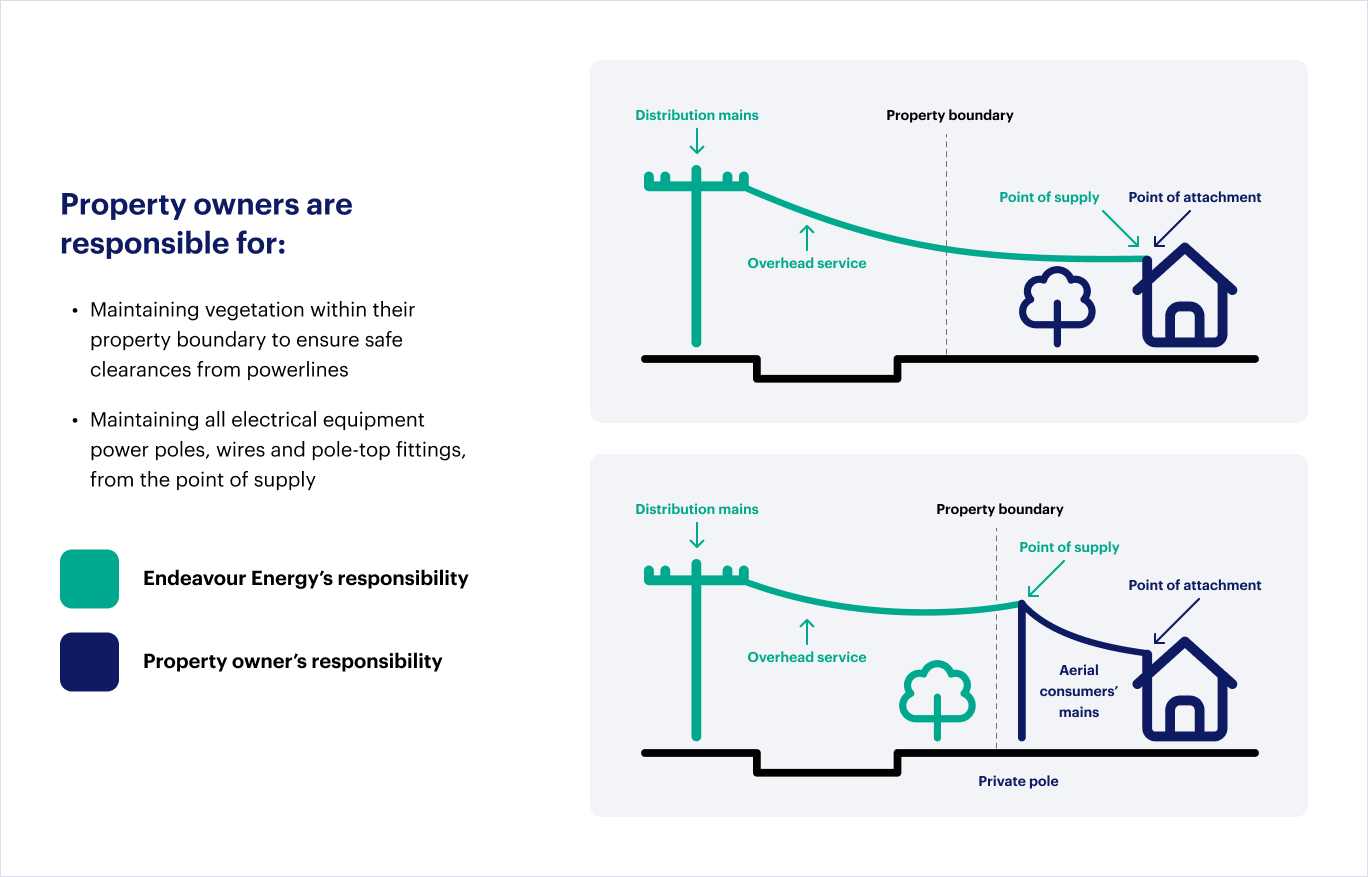
You're responsible for maintaining vegetation near powerlines on your property and maintaining equipment for the point of supply.

Infographic

Warning

Always maintain a 3-metre safety clearance away from powerlines and consider using a professional tree trimmer.

Check for common hazards around private assets

Qualified contractors should routinely inspect and maintain private poles and powerlines. If you observe any common defects or hazards, you should arrange for repairs or tree trimming immediately. 

While we build our network to withstand storms, powerlines can still fall. If you see downed powerlines, stay at least eight metres clear. Warn others to do the same and call 131 003 immediately. Never assume powerlines are ‘dead’, as they can be remotely re-energised.

Warning
Phone 131 003 immediately if you see a fallen or damaged powerline. Stay 8m away.

Trees near powerlines
Vegetation within the minimum safe clearance can touch live powerlines, disrupting supply or causing a fire

Clashing powerlines
Powerlines clashing during strong winds can spark, create molten fragments and potentially cause a fire

Slack wires
Low-hanging powerlines or wires can clash and ignite fires. These low wires might also violate minimum height safety standards

Rotting poles
Poles should be checked above and beneath the ground for decay. Deterioration or rusting below ground

Private asset defect notices

Private assets found to be unsafe will be issued a 'Report of Inspection - Customer Defect'. It explains what the defect is, what is required to rectify the defect and the timeframe in which it should be completed. A defect could include a damaged, rusting or rotting private pole, vegetation that encroaches on service mains or other damage to consumer mains.

If an unsafe situation is detected (and not rectified promptly), we may need to disconnect part, or all of the power to the property. We also have the right to rectify defects within bushfire prone areas and recoup costs if rectification work is delayed.

We recognise there are customers within our communities who may be unprepared for the unexpected cost of urgent repair work required to maintain the safety of their property and our network. While customers are obligated to comply with defect notices, we may be able to assist in getting these defects rectified with an affordable interest-free repayment plan. 

img

Received a defect notice?

If you received a 'Report of Inspection - Customer Defect' notice and would like to know more about it, you can contact us on 131 003.

After you receive your 'Report of Inspection - Customer Defect' notice, you will need to obtain three quotes. Electrical work must be carried out only by a licensed electrician. To rectify this defect, you may also be eligible for a Customer Owned Asset Assistance Loan to help cover the cost.

Where the defect repair involves disconnecting your power at the point of supply, the electrician is also required to be a Level 2 Accredited Service Provider (ASP).  

Details for ASPs can be found on the NSW Government website.

Find an ASP

Customer owned asset assistance loan

If you have received a defect notice from us, you may be eligible for financial assistance. We can help you determine your eligibility. 

Loan eligibility

Loan benefits

Living with easements

Electricity easements play a vital role in maintaining a safe and reliable power across the network. These easements allow us to install, operate and maintain essential infrastructure, such as poles, overhead conductors, underground cables and substations, on private property. They ensure that safety clearance zones are preserved and that our crews can access equipment for emergency repairs or scheduled maintenance.

Understanding easements

An easement is legal permission that lets us use someone’s land without taking ownership. This allows us to install and maintain important electricity infrastructure.

What is an easement?

Why are easements necessary?

How do I know if there are easements on my property?

How do easements affect my property values? 

How am I required to maintain an easement? 

What am I allowed to do on land with an easement?

What if Endeavour Energy damages my property? 

Who can I contact for help?

Warning

For all electrical incidents and emergencies, contact us immediately, on 131 003.

Moving an Endeavour Energy asset

If property boundaries change or development occurs, you may need to relocate one of our assets. To request this, please submit an application to us.